As a horror fan, there are few things as satisfying as picking up the stupidest title and accidentally discovering a gem. Zombie Strippers is one of those gems. Hiding beneath a cheap grindhouse title and Jenna Jameson's lusciously inert breasts is, believe it or not, a small wonder. Initially conceived as a joke, because of course it was, Zombie Strippers tells a sleazy story with brilliant splatstick moments and existential flair, as any good zombie movie should.
The meat of the story takes place in a not-so-distant future where George Bush has won his fourth consecutive term as president (because Bush jokes were hilarious in 2008). As a result, the US is at war with literally everyone. We open on a military investigation of a research facility striving to make a super-soldier serum, which has obviously gone horrifically wrong. Thankfully, the army sent its sexiest unit to take care of business.
The push-up bra is standard issue.
During the initial tour before the zombies hit the fan, the scientists explain that the nature of the disease causes your usual brain-dead, flesh-hungry zombie fare only in the male subjects, whereas female patients maintain their conscious minds while reaping all the undead benefits--super strength, heightened agility, and a bloodthirsty drive to destroy. To make an overly long sequence short, one of the less sexy soldiers gets bitten during the extermination and goes staggering off into the city. He inexplicably stumbles into an underground stripclub, where Kat (Jenna Jameson) is our lithe, shimmery, gyrating introduction to Rhino's.
No matter how you may feel about Miss Jameson, she is an absolute rock star on the pole, and sets the stage for the kind of shiny cheesecake we're in for. She has incredible confidence and control of her body, strutting the stage with a presence that both exudes and transcends her porn star status. According to the behind the scenes, she couldn't be sweeter about sharing her sexy secrets--she actually helped the other girls in the cast with their own choreography on the stage.
The handful of side characters that keep the club running serve both as comic relief and occasional antagonists. Unfortunately neither path lands very well, but no worries since we don't see very much of them. There's the slimy owner Ian Essko (Robert Englund); a smooth black DJ as the voice of reason and possibly the only sane person in this universe; a madame who is cartoonishly Russian from her pastel Lycra pants to tales of squeezing vodka from potatoes in the old country; and a Mexican janitor played by a Puerto Rican actor who is forced to caricature being Mexican to the point that it runs screaming past parody straight into blatant racism.
This is his big monologue.
The real magic lies backstage in the dressing room. Here we are introduced to our girls, each completely unique in their own shallow way. First there is the previously introduced Kat, the star of Rhino's. When she isn't tearing up the stage, she hangs out in her separate VIP dressing room, reading Nietzche and contemplating her own futile existence. She's an intellectual stripper, man, and Jameson plays it surprisingly well. She is not the hooker with the heart of gold by any stretch; rather she is an enlightened woman living in a dystopia who doesn't have the patience for anyone else's sensitivities. She's never cruel beyond mild cattiness or chilly determination, but she doesn't go out of her way to be nice, either. Her pep talk to the newbie stripper Jessy about what it takes to be a real dancer is blunt but not malicious, and is actually precisely the advice you would hope to hear from a veteran stripper.
"First lesson: quit your bitching."
Next is Jeannie, Kat's rival and apparently the least popular stripper at the club, though God knows why since she's got some of the most stunning cleavage I've ever seen. (Maybe it's her penchant for corsets in a house full of nylon bikinis.) Whatever the reason, Jean mostly serves to shoot Kat dirty looks throughout the movie, inevitably leading to a big-breasted showdown.
Ugh, what a cow.
The "lesser" strippers are lesser only in that they don't get nearly as much screen time as they probably deserve. Gaia is set up as an empty-headed sweetheart with self-esteem issues that aren't revealed until it's beyond being relevant, while Sox is more memorable for her crush on Kat than anything else. That, and being a fucking Amazon princess.
Tall girls represent.
Then there's Lillith (Roxy Saint), my personal favorite of the ensemble in spite of and precisely because she's a ham-fisted cartoon of The Goth Chick. She's got the punky schoolgirl outfit, the cigarette-stained grumbling, the heavy nipple piercings, the spidery eye makeup that would make Helena Bonham Carter blush. She even employs a little silver pistol on a chain into her dance routines because she is just so hardcore. I fucking adore her. It shouldn't come as a surprise that Roxy Saint is also a punk rock singer, and a few of her songs are stripped to throughout the film, adding a grimy, sexy flavor to some of the gorier dance scenes. Like Sox, she harbors her own admiration for Kat and is the first gleeful converter to the undead.
SUCH ANGST!
Somewhere in the middle is Berenge, a lapdancer who is physically incapable of caring about anything. She is set up to be a much bigger character than she actually turns out to be, and in the end, the film really doesn't need her beyond faithfulness to its source material (which I'll get to).
Finally, there's Jessy, who is arguably our central protagonist, but it's hard to tell since this movie doesn't stay focused on any one character for too long. She is a good Christian girl who is hoping to raise money for her grandmother's surgery by stripping. This character could, and should, be dead on arrival, but this otherwise walking cliche has a self-aware earnestness with a just a hint of world-weariness that's endearing. She's an innocent without being an idiot.
Just a small town girl, living in a zombie world....
Unfortunately, she's got a literal ball-and-chain dragging her down--her bumbling boyfriend Davis, who keeps following her around the club and being a general skeeze. One second he's pleading with her not to take her clothes off for strangers, the next he's slinking into the shadows to enjoy the show. Just like a dude. Even though Davis is just as useless as any of the other men in this picture, he at the very least serves for Jessy to show her strength. When he begs her to not strip, she hears him out but sticks to her conviction. She doesn't even apologize for his hurt feelings. She makes it clear the whole ordeal has nothing to do with him, and that her grandmother's well-being is "more important than staying pure for you." That's a shockingly progressive direction for a goody-two-shoes character in a movie called Zombie fucking Strippers.
Back to the plot, such as it is. The infected soldier hangs out at the club, the virus quietly consuming him. When Kat struts out for another dance, he rushes the stage and proceeds to rip her throat out. Everyone looks on in horror, but are surprised to find that Kat recovers from her wound quite quickly. In no time, she's ready to take the stage again, gaping flesh wound and all.
And she fucking KILLS IT.
Jenna Jameson decomposes beautifully over the course of the film, but these initial scenes are just stellar. The virus has turned her into a vicious, tireless beast, her feral dancing becoming both erotic and frightening. With her black eyes and deranged grin, not to mention the blood streaked all over her golden flesh, she is a full-on predator on the hunt for meat. And the fellas can't get enough!
Fear-rection.
When the other girls catch wind of the secret to Kat's makeover, they begin converting to zombie-ism for a taste of the power. Kat's posse swiftly overtakes the club's line up, and infected male patrons begin piling up in the basement like rabid dogs. It is up to the remaining survivors to deal with the sexy zombie menace, and if they can't reason with them, they'll have to shoot their way out. Typical silly splatterfest ensues, with a few sets of glitter tits to spare.
Believe it or not, Zombie Strippers is based on what some people would call art. Back in 1960's France, a fella named Eugene Ionesco wrote a little farce called Rhinoceros at the height of the absurdist movement in theater. The play tells the story of a man named Berenger, an everyman who prefers to drown his first-world sorrows and spin philosophy at the local tavern rather than face any real responsibility in life. One day, his musings are interrupted by a passing rhinoceros, which is later rumored to have formerly been a person. Over time, more people in town mysteriously transform into rhinos, rampaging through the streets and destroying property. The remaining non-rhinos try to rationalize the bizarre events and attempt to figure out a cause, but one by one they surrender their humanity to become something else.
Soon the town is lousy with rhinos, all except Berenger and his lady love, Daisy. The two decide to make the best of things and try to go about remaining human despite being surrounded by dangerous animals that were once their neighbors. Over time, the transition to rhino-hood becomes more and more attractive to Daisy, and she eventually leaves to join the herd. Berenger struggles to hold on to his humanity, finding himself seduced by the call of the rhino as well. In the end, he decides to resist temptation and actively fight against the rhino invasion.
The play has a few themes floating around, but the most central is the notion of conformity. Ionesco presents us with normal people who inexplicably become beasts, and the remaining humans willingly follow them--not all at once, but slowly. Through conversation and persistent rationalization, they convince themselves that making the change is simply better than remaining what they are, as if it's a new level of enlightenment, a superior state of being. The play speaks directly to the insidious nature of Nazi propaganda, but could just as easily be applied to any number of hostile movements throughout history--the Salem witch trials, the Satanic Panic of the 1980's, even now with the marketing of our most recent election--a hideous idea that presents itself as profound logic, taking root in the impressionable individual and gradually creeping into public consciousness as the status quo. Berenger represents man's resistance to savage herd mentality, and he ultimately finds direction by pointing away from everyone else.
In these modern times, zombies are an ideal replacement for rhinos. Since Romero's triumphant premiere, they have always represented our most base selves, stripped of empathy and reason, hungry for domination (and flesh). Zombie Strippers takes this and cranks it up to maximum parody levels, but the themes remain the same. You could even dig a little feminist message out of the fact that the base male is a mindless drone whereas females can retain their speech and get bitchy superpowers.
Wanna lapdance?
Personally, in 2018, the zombie theme is largely played out, and by now even the most inventive twist still often rings a bit stale (with a few choice exceptions). But sometimes art doesn't strike at the right moment and takes a few years for anyone to recognize it for what it is. I believe Zombie Strippers is ripe for a comeback, not only for its timely political unrest, but also for its feminist themes, however flimsy they may be in context. For me, I always enjoy an ensemble of beauties taking on their shitty situation, so Zombie Strippers fills a void for me in the same way that Showgirls does, even if the amazing quality and vibrancy of their female cast doesn't get near as much screen time.
I love bad movies--a deep, true love without irony and only a hint of malice.
My idea of a good time is getting people together with a couple drinks and taking the piss out of some poor fool's honest effort at filmmaking. By this point, the world has caught up with the joys of playing the home version of MST3K, and seemingly everybody has a favorite bad movie. There is no shortage of bad movies that have been agreed upon as "classics" and are must-sees for anyone hoping to have fun with an unintentional comedy. Most of them, like Birdemicand Fateful Findings, are truly awful in their execution and helplessly funny in their sincerity--ideal for a perfect bad movie night.
But not all bad movies are created equal. There are the bad movies that are not fun, not hilarious, simply bad--stiff, boring, joyless. These are the movies have no redeeming qualities even in their most memorable moments. These are the movies that make people like me angry, especially when the world at large recognizes them for something they simply are not. On one side of the spectrum we have Sharknado, a series that is gleefully bad on purpose and yet doesn't do a lot to stand out from your typical Scary Movie fare--stupid, yes, and ruining the definition of "so bad its good," but ultimately harmless.
On the other side, we have the movies that are exhumed from the ashes of their dismal box office returns and held up in campy reverence when they were better off remaining forgotten. These movies are what memes are made of, doomed to be an ironic joke that everyone is in on until it inevitably implodes into anti-comedy. And what is arguably the most iconic, overused, anti-joke in Internet history?
Well, I say, no more. I cannot let the memes represent this film any longer. I cannot abide another day of all the top ten lists out there lying to the bad movie novices of the world. Please, listen when I tell you that The Wicker Manis a terrible film in every sense of the word.
The original Wicker Manand its remake follow essentially the same plot: a police officer is summoned to a secluded island where a young girl has gone missing. When he asks the locals about the child, they give conflicting stories--some claim she's dead, others say alive, and some claim to not recognize her at all--and they seem amused by the officer's growing frustration. He discovers that the island is economically dependent on their crops and the people have turned to paganism to encourage bountiful harvests. The staunchly Christian policeman observes their practices with confusion and horror, and it only encourages his frantic search for the missing girl. What little evidence he collects leads him to suspect the girl will be sacrificed at the approaching May Day celebration, so he infiltrates the festivities hoping to find her before the lord of the isle can reach her first. He realizes all too late that it's all been a ruse from the beginning, and the real sacrifice is him. The film ends with the officer locked in the belly of the enormous Wicker Man as the islanders light the pyre and sing a song, joyfully watching their sacrifice burn.
To get it right out of the way, I do love the original Wicker Man. However, that love is not blind enough to not notice that it's a bit of a mess, at least the cut I have. The film was famously hacked to pieces by the ratings board upon its original UK release, and although a director's cut does exist today, you have to check the box very carefully to know which version you're ordering on Amazon (I did not). Either version is far from perfect. It's the seventies, so things like sluggish pacing and stilted acting are forgivable, even charming. Other things--like the casual nudity, impromptu musical numbers, and wacky paganism--are just as baffling as they are deliriously entertaining.
If the song doesn't get stuck in your head, the wall-smack ass-dance will.
But then again, this disjointed dreamy style seems entirely intentional, in order to place the audience in the same position as our hero, Sgt. Howie (an adorably uptight Edward Woodward). We are as confused as he is throughout the film, following clues that lead nowhere while the cagey townsfolk stand aside and snicker. It makes that final twist all the more effective when we realize the entire thing was an elaborate game, not to cover up a murder but to lead a lamb to slaughter. What the film lacks in rational sense, it more than makes up for in sheer weirdness. And if nothing else, Christopher Lee's performance as the too-cool turtleneck wearing pagan philosopher is worth the price of admission.
Fast forward to 2006, and our post-9/11 world is fraught with swaggering cool guys, gritty yellow filters, and aimless anger at no particular source.
Let's start with Nicolas Cage, because why would we begin anywhere else? Let me make this perfectly clear: I love me some Nic Cage. I can get in a Raising Arizona quote-off with the best of them. I place Face/Off not only as one of my favorite movies of all time, but also the only action movie I'll ever need. One day, I'll write out all my feelings aboutVampire's Kissas the masterpiece that it truly is. I love Nic Cage in the most unironic way any woman can.
Exhibit A.
That's why it hurts me so deeply that this is the performance my fellow bad movie lovers hold up as the best of Crazy Cage. It is simply not the case. He's too National Treasure in this for my tastes, cool and controlled--mumbling all his lines with that jaguar-purr voice of his like a low-rent Jeff Goldblum and barely creasing his magnificent face beyond a stoic scowl. It's disappointing given what the internet prepared me for. He is so reserved and low-key in the bulk of this movie that it's almost a relief when he starts sucker-punching women. Once he finally cracks and the "How'd it get burned?!" scene appears, I am so thoroughly checked out of the film that I don't even care how hysterical he is.
Even the famous "Not the bees!" scene couldn't save this sinking ship, which explains why it wasn't included in the theatrical cut. With its popularity as the absolute funniest thing to say anytime someone mentions bees, it's easy to forget that the iconic moment is completely pointless within context. The villagers pour bees in his bonnet till he passes out, only to instantly revive him with a hit of EpiPen so he can be awake to meet the title character. Completely, utterly pointless. It was nothing before the internet, and it's less than nothing now.
Aside from the fleeting moments of Crazy Cage in the final act, the movie offers nothing in the ways of entertainment value, leaving plenty of time for me to just sit back and notice how hateful it is. Not as in "I hate this movie" (which I do, obviously), as in the film's essence, the bitter mood that permeates every frame. This movie is marinated in thick, salty hate gravy that has a very direct and blatant target, and it's all thanks to an angry little man named Neil LaBute.
This is a guy who has a booming social life and doesn't participate on even one hateful message board.
If you're familiar with LaBute's other work, you'll know that his material tends to be infused with a palpable anger towards women. One only needs to watch about four minutes of this scene to get a real clear idea of how the man's mind works, and how much he would like to convince you that his view is the unsentimental truth. You could argue his work is strictly satirical and thus a thoughtful commentary on toxic masculinity, but there is a line between satire and rampant misogynist fantasy. LaBute is either unaware of that line, or he's actively dry humping it while flipping you off and screaming "Just think about it, maaaaan!"
Though the two Wicker Man films are similar in many ways, LaBute made a few tweaks to mold his vision of the story. Namely, he made Summerisle a matriarchal society where the few men that live there have their tongues removed and serve as laborers. To hammer in that imagery just a little deeper, the island's main export was changed from apples to honey...meaning bees...meaning a queen surrounded by witless male drones to do her bidding...and macho man Nic Cage is deathly allergic to bees. Subtle.
WOMEN ARE SCARY!
Remember that trend in sci-fi movies back in the day of men discovering lost civilizations or alien races comprised entirely of sexy ladies? There was a glut of these in the '50s and '60s, blatant male fantasies where one or two dudes stumble into a tribe of exotic babes who have never seen a man before and are just dying to have someone tell them what to do. Wicker Manis like that, but in reverse--it carries itself with that same smug air of the masculine know-it-all stumbling into the land of women, but instead of portraying the women as empty-headed natives, they are a calculating pit of vipers. They know exactly what a man is, what he wants, and what to do with him. Even LaBute's dumb sexy fantasies are injected with an insecure, paranoid dread towards the opposite sex.
The remake makes an interesting choice by pitting one man against an all-woman society, but fails to do anything interesting with it in terms of commentary, if that was indeed the intent. The villagers speak in veiled language like the first film in order to mislead our hero, but the added female factor makes it feel like a pointed jab. Worse than the double-speak are the non-answers, Cage's direct questions earning no more than a menacing giggle in response.
If LaBute is trying to say something with all this, it comes across as little more than a man screaming into a camera about how girls are so weird and scary. I just get this image of some moment during production with Ellen Burstyn approaching him to ask about a scene and LaBute just gaping back at her in terrified confusion as he attempts to understand how she's making noise come out of her face-vagina.
You are a sad, strange little man.
Aside from being inherently sexist and not nearly as provocative as it thinks it is, The Wicker Man's greatest crime is that it is boring as all hell. Even if you can squeeze a smidge of enjoyment out of Cage's mild freakouts or the absolutely baffling way in which he's dispatched, it is not worth the dismal slog it takes to get there.
This film does not deserve a spot on your bad movie list. It is purely, concretely, irrevocably bad from top to bottom, completely unworthy of the fame it has achieved from its laughable awfulness. There are such better bad movies out there, and such better Nicolas Cage movies, and that Venn diagram is so often a beautiful perfect circle. There are better ways to waste your time.
Trust me, I am a Nic Cage expert.
Exhibit B.
So please, if you must deduce the gifts of Nicolas Cage to a meme, make it a performance that is actually meme-worthy.
The year is coming to an end, and you all know what that means: the days are growing shorter, the nights are filled with twinkle lights, and every radio station plays songs that involve more bells than usual. Yes, it's the holiday season, the magical time of year from November to New Years when we gather together to endure the company of our families. If you're fortunate enough to be apart of a family that is just as happy and adorable as your Christmas cards, then bully for you, it's another year of wonderful memories to be shared. But for many of us, the pilgrimage to Grandma's house is filled with misery and dread.
Not to brag, but nearly every gathering among my extended family has been punctuated with a memorable bit of unpleasantness--from the Christmas when a great aunt sized up my perfect cousins' accomplishments against my own for everyone to hear, to the Thanksgiving when my mother's sister took too many Quaaludes and passed out in her mashed potatoes at the dinner table (bonus points for the Easter that my mother-in-law told me, in grave detail, all the ways in which her pets had passed away over the years--here's a hint, none of them were from old age).
For as traumatizing as it can be to actually live in a fucked up family, there is something compelling about seeing them on film. Whether it's wacky comedies or Oscar-bait drama, genetically-shared dysfunction lends itself to all the best parts of a great movie: an ensemble of quirky characters, long-stemming grudges and deeply-held alliances, dark secrets revealed, and more than a few painfully relatable moments. When translated to horror, the family dynamic is transformed into something entirely new and even more fascinating. It introduces the idea that evil can be ingrained, instructed, and even nurtured.
Rob Zombie's premiere to the world of film took the Texas Chainsaw Massacreand the Manson family and blended them together to make a malicious technicolor hick stew. House of 1000 Corpses introduced us to the Firefly family, consisting of Mama Firefly and her grown children from multiple fathers, at least one of them being bred from the repulsive clown Captain Spaulding. Otis is the philosopher of the family, preaching venomous nonsense to the terrified cheerleaders he keeps tied up in his room. Baby is the only girl and wears it proudly, emulating her sultry mother and Hollywood vixens as she lures in passers-by (and cackling maniacally as she scalps them). The other Firefly children--bear-man mechanic Rufus and mute giant Tiny, plus the scattering of mutated fetuses that are preserved in jars around the house--lurk in the background, adding to the weirdness. The Devil's Rejectsonly brought us closer to the Fireflies when Otis, Baby, and Spaulding go on the run, taking us on the road with them as they evade capture from a sheriff with a grudge, with a few face-skinnings and familial spats along the way.
The contrast between the two films is stark and many fans will loudly proclaim their preference of one over the other. I feel they work as a series if you look at them as two completely different perspectives of the same thing. House of 1000 Corpses is a "normal person's" view of the family, a collection of grotesque figures who act completely unhinged in every conceivable way. The colors are harsh neons cutting through inky darkness, reality upturned by unexplainable visions. The experience of spending an evening with the Fireflies is not unlike Captain Spaulding's funhouse murder ride, over-the-top horrors popping out of the darkness to disturb and delight.
Meanwhile, Devil's Rejects takes a less spectacular approach. The Fireflies are the same people, only now we see them the way they see themselves--murderers, yes, but not cartoons. They're sloppy, grungy, regular folks from the sticks with questionable interests and zero social skills. Their reality isn't heightened because this madness is just what they do: manipulate those unfortunate enough to encounter them and take all they can get before taking flight again. Their actions are monstrous, but Devil's Rejectsshines between the carjackings and taking of hostages when we get the chance to know them as people.
They defend their home and each other with a hail of bullets. Otis and Baby squabble like kids in the backseat. Otis and Spaulding maintain a palpable "fuck you Dad!" rivalry. Mother Firefly speaks of her children's exploits with all the gooey pride of a mommy blog. They're a real family, and it's endearing to see who they are when they're not putting on a spookshow for their captive audience. That's probably why it's a little heartbreaking that the inevitable shootout with the police ends in their bloody deaths, but it is interesting that in this moment, reality is heightened. Because if you were a murderous maniac from the boonies and your years-long spree finally came to the end at the wheel of a top-down car headed towards a roadblock, wouldn't you imagine yourself going out guns blazing and "Freebird" blaring as you speed into oblivion? Of course you would.
Spider Baby is one of those movies that may have been lost to time if not for a Blu-Ray release in 2015, and even now it's still not exactly revered. I wouldn't have known about it were it not for a small review I read that I can't even remember the source for, and thanks to my Shudder subscription (they don't sponsor me or anything, but seriously, it is SO worth $4.99 a month), I was treated to the mad delights of the Merrye family.
The Merrye children are afflicted with a disease so peculiar and rare that it's named after them. The beginnings of puberty are a difficult time for all of us, but imagine if it only got worse from there (well, worse than adulthood). Merrye syndrome kicks in during the early teen years, the victim's brain degenerating to childishness with further regression leading to a completely feral state. Unfortunately for the players inSpider Baby, the Merrye children are already well into the stages of their disease.
Eldest son Ralph (an explosively expressive Sid Haig in an early role) is the most far gone, regressed to complete muteness and his brain reduced to a primitive state (the language of the 1967 film is decidedly more colorful). Sisters Elizabeth and Virginia are more lucid than their brother, but the evidence of their degradation is even more eerily apparent. Pretty, soft-spoken Elizabeth is dainty and polite, an otherwise perfect debutante if not for her limitless capacity for hatred. Most fascinating of all is wild-eyed Virginia and her obsession with spiders, her favorite game being to sneak up on people and trap them in her web. My favorite moments in the film spring directly from Virginia: her dark features, vacant yet calculating expression, coquettish sultriness, and most of all, the delicious way she says "spiderweb."
The members of the family that have made it to adulthood--thus total savagery--are kept locked away in the basement while the children's father lies decomposing in the upstairs bedroom. All of this madness is kept under control by the family's loyal caretaker Bruno (Lon Chaney), but just barely: Ralph has the mind of a toddler and the appetites of a grown man, while Virginia has a habit of "stinging" people with butcher knives. Bruno is already reaching the end of his rope by the time distant cousins arrive sniffing after the family estate. He does his best to portray the children as innocent victims of a misunderstood disease. Despite his efforts, the children undermine his claims at every turn, offering their guests roasted alley cat and engaging them in games of "playing spider" before the really freaky stuff starts. Realizing the grim future for his beloved wards should the truth reach the public, Bruno knows the only thing to do is to finally end their suffering, and his own.
Spider Baby has certainly not aged well in a politically correct sense, with terms that we have virtually outlawed today being thrown around like confetti. But the heart of the film, and its entire appeal, lies in its preternaturally talented young cast, especially the two sisters. Elizabeth with her blonde hair and prim white dress, her kitten-soft voice cooing, "Don't you just hate her?" Virginia with her twitchy yet graceful movements and intense gaze, only showing her sweeter side in the presence of her spider friends. It's a shame that the actresses playing Elizabeth and Virginia didn't rise to the cult status of their male costars, because they truly shine as haunting icons on par with the Grady sisters as some of the greatest terror siblings put to film.
Despite and perhaps because of their condition, the siblings clearly care for one another, and their shared adoration for Bruno causes them to trust him completely, even as he tearfully leads them to their deaths. Their ending, like the Firefly family, is surprisingly bittersweet. The movie is still somewhat obscure, not showing up on as many "top ten" lists as it deserves, but it does still maintain a charming website that provides in depth information on the film itself as well as behind the scenes goodies. And, like all the great campy classics, it did inspire a musical adaptation.
And speaking of musicals...
Takashi Miike is responsible for some of the most traumatic horror films to come out of Japan in recent memory, and that's saying something given the wealth of nightmare fuel that wonderful country has blessed us with over the years. His most notorious works are Ichi the Killer and Audition, both renowned for their graphic depictions of torture, deeply flawed characters, and all-around insanity. My personal favorite of his work brings the agony and the ecstasy together in Imprint, a gorgeous installment of Showtime's sorely missedMasters of Horror series. Despite his talents in the horror community, Miike has never been a slave to genre, most notable in his home country for action films, which quite often veer into bouts of comedy, fantasy, and cartoon physics. This is to say that, if you know the man's work, then you know to expect the unexpected.
The Happiness of the Katakuris takes a detour from these other families in that they are not introduced to us as murderous outcasts, but instead must rise to madness. The Katakuris are a simple family with a simple dream of trying to get their isolated bed and breakfast off the ground. Patriarch Masao (Kenji Sawada) places all his hopes on the lofty promise of a highway being built in the area, but the reality of constant work and nothing to show for it hangs heavy on his family. Finally, one day, a guest appears--unfortunately, he's picked this as the site of his suicide. The family is devastated when they discover the body, but are even more distressed at the idea of word getting out that their first guest died on the property.
They bury the body and no sooner are they done than another pair of guests arrive, only to promptly drop dead during their stay as well. The Katakuris are innocent bystanders in the ensuing string of unfortunate incidents, trying desperately to maintain normalcy while cleaning up after their guests' tragedies. And what better way to keep a smile on your face than a rousing sing-a-long? The film doesn't reveal itself to be a musical until the bodies start piling up, but when the lighting changes and everyone starts singing and dancing their feelings, boy howdy.
Miike runs the gambit of any good musical, from the longing "I want" song to the operatic dialogue exchange set as lyrics. The soundtrack ranges from effectively hilarious to surprisingly touching. There are not one but two love ballads in this flick, which beautifully juxtapose one another in style and sincerity. The first involves single mother Shizue seeing a handsome naval officer and the two professing their instant attraction through song, literally flying on wires across a rose-filled ballroom. It's cheesy and completely over the top with no hint of reality, and that's entirely the point: the officer turns out to be a con man, and it's evident from the get go that his grand gestures are all bullshit. Meanwhile, the second love song is between Masao and his wife Terue, supporting one another at their lowest moment through a disco ballad that's shot with all the soft-lit loveliness the 70's could offer. It's still cheesy, but it's a more palatable kind of cheese: the cheesiness of true affection between two people who are going to stick it out till the bitter end. It ends up being kind of beautiful and awfully sweet.
Also worth mentioning, this clip is the film's opening scene, and it has absolutely nothing to do with anything that follows besides setting the bar for insanity.
Please, do yourself a favor. Just watch it.
We all think our families are crazy. We all watch the Hallmark movies every year and wonder how great it must be to be apart of a happy (white upper-middle class Christian) family like that, but we all know the hard truth. Nobody is perfect, so certainly a collection of people from the same gene pool forced together in one room can't even come close. But family is what you make it, and often that means setting aside your differences and coming together for a common purpose, from outrunning the cops to withholding a family secret to burying a body or five. Thankfully, for most of us, it can be as simple as avoiding another dinner that ends with Mom crying in the backyard.
I was eight years old when The Blair Witch Project came out, and I knew from the first trailer that I was absolutely not interested in seeing it. Being a notorious scaredy cat as a kid, I steered clear from scary movies, despite my intense curiosity about them. The Blair Witch Project boasted being both terrifying and true, so there was no way in hell I was going near that horrorshow.
I may have gone my whole life without giving Blair Witch Project another thought if it wasn't for my childhood friend Hannah, who watched plenty of scary movies and of course had to tell me every frightening detail as soon as she could. I give credit to Hannah for introducing me to many awesome formative things during our childhoods, but her affection for horror movies were never something I could bring myself to follow her on at that age. (It probably irritates her how much now I claim to love horror when I was once brought to tears refusing to watch Darkness Falls.)
So our elementary school was in the middle of farm country, mostly surrounded by cow fields, with a small pine forest bordering the back of the playground that separated the school grounds from the farmland. The forest featured a path that was around two miles, and it was common for our P.E. period to take place hiking the trail. Usually it was a rather nice walk, even for an indoor kid like me. The forest was especially lovely in the early winter when the mornings were bright and cold and you could just enjoy a walk in the woods while chatting with your friends.
It was during one of these early winter trail walks on a cloudy morning that Hannah decided to share with our group how she had just seen The Blair Witch Project...and how much the woods around here reminded her of the ones in the movie. I brushed her off at first, but Hannah continued to explain more about the movie, and claimed to see more and more familiar symbols all around us. The forest grew darker as we walked, the air seemed to grow colder, and by the halfway mark of the trail, I was in a cold sweat and begging her to shut up.
It was around this point of peak jitters that the trees broke to reveal the neighboring farmland, where there just so happened to be the sunken, rotting carcass of a cow resting against the fence. Any other day, it would have been nothing. That day, it was a hideous omen from the witch of the wood, and we all ran screaming for our lives. It wasn't until we managed to tear past all of our classmates and burst out the other end of the trail into the thankfully bright playground that I felt safe again.
I will never forget being doubled over and out of breath, panicked for my very life, when I heard Hannah say, "Oh, guys. I just remembered...the Blair Witch is in Maryland."
I could have killed her.
Some years have passed now and I have since come to a place of peace about that embarrassment, but it's always stuck with me as one of my first brushes with true horror. It also remains my main argument when talking about the resonating potency of The Blair Witch Project. Even without seeing the movie, even in broad daylight with people all around me, I was still captivated and terrified just listening to a classmate's summary of it. Hannah had told me about plenty of scary movies, but this one was visceral, raw, absolutely within the realm of possibility, even in our own backyards. That's the power of a good scary story--the kind that gets under your skin and holds you tight in its clammy grip, no matter how safe you feel in your fluorescent-lit modern world.
It goes without saying that The Blair Witch Project is amazing, a fine specimen in the masterclass of horror. All the "true story"and "found footage" hubbub aside, the movie stands on its own as an amazing slow burn of paranoia and terror. I am naturally unnerved by spooky sounds at night, people yelling at me, and camping trips, so this movie is some of my deepest anxieties all mashed into one black-and-white nightmare. But it's not just the movie itself that spawned an obsession that keeps me coming back at least once a year...it's the ever-expanding, ongoing project of the Blair Witch.
It's difficult to put into words what a miraculous thing the web of Blair Witch lore is. The idea that it extends as far as it does is remarkable just given that it came out in the infancy of the internet, and still set the stage for Cloverfield-level ARG obsession. Aside from the original website , which is still accessible and delightfully archaic, there were several books as well as three video games following separate angles of Blair Witch lore.
Most fans are aware of TheCurse of the Blair Witch, the TV mockumentary that delved into the bloody history of (fictional) Burkittsville. The special was comprised of unused footage from the film--mostly talking head interviews with locals, detectives, and folklorists. It follows all the same beats of any of the Dateline and In Search Of-type shows that were explosively popular at the time, and lent just an ounce more legitimacy to the true story claims. As far as publicity stunts go, it's impressively produced, admirably straight-faced, and--if you didn't know any better--absolutely convincing. The special can be found in the features of the DVD, but it's just as easily accessed on Youtube.
Lesser known are the othermockumentariesfloating around Youtube that make use of even more deleted scenes and dive even further into history, one even going so far as to veer away from witchy territory to explore the story of Rustin Parr, which frequently parallels (despite predating) Making a Murderer and Cropsey. All of these feature casts full of natural actors playing experts and witnesses, some making appearances in multiple docs. All of these people are so effortlessly convincing that it causes one to wonder where they are now (hopefully they're at least doing local theater because these folks got charisma).
So what of The Blair Witch Project's actual legacy--that is, as far as pop culture is concerned? It remains one of the most successful indie films and one of the most profitable films of all time, with its microscopic budget earning back $250 million worldwide. While it didn't exactly invent found footage, it set the standard for many, many movies to come in the revolution of shaky cam cinema. It remains one of the greatest tricks Hollywood ever pulled, as the film was able to retain its "true story" badge for quite some time. True enough, anyway, to harass the residents of the real-life Burkittsville, Maryland into completely disowning any connection to the movie, going so far as to change to design of their town sign to prevent fans from stealing it...again.
There was a sequel the following year that abandoned the found footage angle to adopt a slicker, more Scream style in an attempt to be in fashion with other horror movies at the time. Personally, I have a soft spot for Book of Shadows because it's just good fun, but I understand why it isn't fondly remembered among horror fans. Its meta-humor isn't exactly respectful to the utter grimness of the original, and it suffers from major schizophrenia in the editing room, but somehow despite abundant silliness, it ends up being kind of wonderful and I'm glad it exists. (Plus, seeing baby Dodd Gerhart be a stoner goofball tour guide is never a bad thing.)
As far as the "official" sequel is concerned....it's not great. Blair Witch (2016) attempts to literally follow in the footsteps of the original by having some teens trek into the woods where Heather and her crew disappeared, only this time there are more people and more cameras. I can appreciate what the movie is going for, but aside from the stick figures and passing mentions of familiar lore, it isn't much different from any other run of the mill, forgettable found footage ripoff. (Seriously, what was even the point of having a drone in this film?) I will give them credit for the fleeting reveal of the witch and how she looks pretty close to what I always pictured (despite being fairly derivative of the monster from [REC], but I'll let it slide). Unfortunately, it takes away from the perfect mystery of the original film, which drew a lot from what we didn't see.
See, there was always a plan to show the witch. Near the climax of the original film, Heather and Mike flee their tent in terror and take off running into the woods. At some point in the chaos, Heather looks to the side and screams "What the fuck is that? What the fuck is that?" The camera jostles all around, but all we see is darkness, trees, and Heather running up ahead.
What we do not see is the paid extra standing somewhere off in the distance wearing a spooky getup and trying to look menacing, because the camera simply didn't catch him on film. The failed effect managed to remain in the final cut because, despite itself, it becomes even more chilling when we don't see anything. It remains one of the film's most frightening moments, because we are forced to wonder what Heather is seeing, if what she sees is even real, what could make her scream like that.
That's the true magic of TheBlair Witch Project, the same magic that sent me running for my very life through the friendly, familiar woods around my elementary school playground. It's because the simple horrors are always the most effective. The very idea that what we think we know can be utterly useless, that three people with maps and survival manuals and all the modern day know-how could wander into the woods and never come back. It's a giggle in the dark, figures made of twigs and twine, a thousand tiny handprints on a dirty wall. The idea that something ancient, "of the Old World," still lurks in the wilderness, undisturbed until some overconfident millennial stumbles into its territory.
SPOILERS AHEAD FOR SEASONS 1 & 2 OF STRANGER THINGS
Just like most of you, I devoured the second season of Stranger Things in a matter of hours and am now dealing with an epic hangover full of feels. There is very little in this world I'm not cynical about, but Stranger Things has a way of bashing down every one of my walls with thumping synth bass and homegrown nostalgia. If you're anything like me, you've already discovered the wealth of essays and thinkpieces online explaining all the many ways in which the show is so damn perfect, so there's no need to repeat the obvious power it has over its viewers. But it's not just about the inversion of tropes and fantastic music that sets Stranger Things so high in the ranks of great television--it's the characters.
At the end of the day, all these pitch-perfect 80's references wouldn't matter much if the people living within them were just as pastiche. And Stranger Things' greatest strength lies in that magic formula of the familiar turning into something new, just like childhood itself. That magic makes watching something as simple as a bunch of kids riding their bikes and sniping at each other over D&D lore a joyful experience--a vibrant feeling of nostalgia for our own childhoods as well as an almost parental pride in watching these kids grow up.
Even characters that start out as cliches slowly become something else entirely unexpected: ballet-pink Nancy realizes she is secretly a badass, known nutcase Joyce turns out to be seeing more clearly than the entire police department, and Scumbag Steve transforms into the world's greatest babysitter.
I need this Funko figure.
Steve is one of those characters that, when you're discussing the show with a group, the very mention of his name causes the whole crowd to stop and spit and scoff and say "Steeeeve" with such utter contempt that no further commentary is necessary. It was one of the absolute truths of Season One: Will Byers is trapped in a parallel dimension, the government is in on it, Hopper is not to be fucked with, and we all hate Steve.
Like anyone, I had a lot of feelings about Steve from the beginning, mostly negative. My first time watching the show, it was instant, intense hatred for this poofy-haired, over-confident King Shit who was really bad at interpreting the word "no." He was in every way the asshole we all knew from high school, some swaggering peacock that would only look your way if he wanted to fight or to fuck. So as much as the show calls to mind all the wonderful things from childhood, Steve served as a reminder of a lot of the crappy ones. This hatred for Steve soon dulled into mild irritation, as I was assured that soon enough he would be punished for his sins, hopefully by way of getting gobbled up by an interdimensional beast.
But then something happened: Steve got his ass severely kicked.
It was glorious.
After this severe spanking to his ego, Steve's more human side begins to emerge. He sees the error of his ways with surprising sincerity and immediately begins trying to turn things around, starting with cleaning up his slut-shaming graffiti about Nancy. It's this moment that beautifully illustrates the beginning of Steve's redemption: he made a big bombastic display of his hurt feelings for the whole town to see, only to realize how immature and hurtful it was towards a girl he genuinely cares about. Now he has to clean up his mess, and it's not coming out easily. For once, his popularity and charm will do him no good. He really needs to scrub in order to erase this mistake.
He follows this up by going to Jonathan's house and apologizes for his general shittiness with nearly frantic humility, only to stumble into a house full of booby traps and a very pissed off monster. And it was at this exact moment that Stranger Things busted through my last remaining wall of cynicism and I began to fall helplessly in love with Steve Harrington.
My thoughts exactly.
The Duffer Brothers recently revealed that Steve as a character was exactly the hollow douche he appeared to be until Joe Keery auditioned for the role. They said that his natural charisma and likeability instantly changed the way Steve was written, and you can see it as early as the very first episode if you really look for it. Joe is able to show through subtle expressions and delivery that some of his more dicktastic moments are tinged with just the slightest flicker of discomfort. Perfect example--when Steve casually destroys Jonathan's camera in what is ostensibly a defense of his lady's honor but in reality is just a dick move, you can see in his body language how instantly he regrets it. But, ever the tough guy, ever the King Shit, he walks away before his guilty conscience can chime in.
See, the thing with Scumbag Steve is that he is a scumbag because that is what he feels he is supposed to be. He grew up wealthy, he knows his way around a can of mousse, and he "kinda looks like" that guy from Risky Business (yeah, sure Steve), so he poises himself be That Guy. That Guy gets all the ladies. That Guy beats down anyone that steps to him. No one says "no" to That Guy. Maybe the reason we are so inherently bitter towards Steve in Season One is because we can sense that he's just a big phony. All that swagger, all that posturing--it's all fake, merely a performance of the kind of guy Steve thinks he should be. And for all intents and purposes, it's been working for him quite well, up until he begins courting Nancy Wheeler.
The full scope on my feelings for Nancy are for another blog, because I have a lot to say about how damn proud I am of my girl (actually, I probably have enough material gathered up in my head to write long-winded, overly emotional thinkpieces for every single character in the cast), but for our purposes today, let's focus on the profound effect she has on breaking down the thick layer of sleaze that coats Steve in Season One.
From the jump, Nancy is not swayed by Steve's usual tactics of seduction--you know, those old romantic gestures of shoving a girl up against the bathroom wall and interpreting a cancelled date as an invitation to sneak in her bedroom window. To his credit, for all his rapey vibes in the beginning, Steve does catch on pretty quick that Nancy is different from his former conquests, and what starts out as just another notch on his bedpost quickly slides into something more sincere. Nancy's sweetness and genuine decency begins to chip away at Steve's need to look cool in front of his friends, and when she blows him off to hang out with outcast Jonathan Byers, it is both an unexpected blow to his ego and a wake up call that maybe being a dick to everyone isn't the best way to show that you care.
But this is still gross.
The end of Season One shows Steve blissfully happy to be snuggled up with Nancy in his Christmas sweater watching It's a Wonderful Life with her folks, while she listlessly stares off in the distance, leaving us questioning just how long this relationship can last. Season Two wasted little time in answering us, since the second episode ends with Nancy drunkenly revealing her true feelings about their seemingly perfect union: "It's all bullshit."
To be fair, he had it coming. You do not fuck with a girl's white sweater.
As if this wasn't enough, Steve also has to tangle with new psycho in town Billy, who is aiming to be the new king of the senior class. If Steve was tempted to go back to his old ways after being dumped, any attraction quickly sours with seeing the ugliness that radiates from Billy and all his unhinged alpha male aggression. Heartbroken and humiliated, Steve is left to stumble around with a new identity that has made him a more decent person but causes him to lose his place within the high school food chain. Seeing no other option than to return to the only good thing he knows, he goes to her house to try to reconcile. But instead of finding Nancy, he runs into Dustin who says he needs the assistance of a certain bat armed with rusty nails, and suddenly, everything falls into place.
Scumbag Steve becoming Babysitter Steve is one of the most magnificent transformations of a character I've ever seen. It's on par with Jaime Lannister going from an incestuous bloodthirsty prick to a one-handed man of honor. In a season that seemed to pride itself on attempting new team-ups between characters, this one is the last thing you see coming and one of the most delightful surprises of a show that aims to shock. As much as I love Hopper being Eleven's new dad, there is little that compares to the feels of watching Steve and Dusty walk down the railroad tracks talking about girls.
And the benefits of quality hair care products.
If you're one of the non-believers that chalked up Steve's heroics at the end of Season One as merely an attempt to win back his girlfriend, then Season Two should put that shallow read to rest. Once again, Steve is inadvertently dragged into a second encounter with the Demogorgan(s), but this time it is undoubtedly selfless. He willingly puts himself in danger to help--and then fiercely protect--a bunch of kids that shouldn't mean anything to him. Not only does he square off against a gang of literal monsters, but he even throws himself in front of the testosterone-fueled freight train that is Billy when he comes looking for his stepsister. When he wakes up from his severe ass-whooping in a car being driven by a thirteen-year-old, he has one of the most fantastic freak-outs put to film. And come on, tell me you didn't get chills watching him swing that bat again like a goddamn superstar.
Come at me, bro.
Nancy's influence certainly contributed to Steve's metamorphosis, but ultimately, it does not define him. Because for all the softening the love of a good woman can do to a hard man, it is obligation and responsibility--these moments that we are sometimes accidentally thrust into--that reveal who we truly are. And, surprise, Steve reveals that not only is he a good person, but also the King Shit he always tried to be, only in a different way than anything he could have prepared for. Stranger Things is that rare perfect show, striking the balance between exploiting our nostalgia and expanding upon it, teasing out unique perspectives on old tropes while introducing us to rich characters who are both comfortingly familiar and refreshingly new. But Steve Harrington stands out among this wonderful cast by becoming something entirely unexpected: a hero.
I would describe my reading habits as "fits and bursts." When I was younger, I was a definition bookworm, but these days I'm choosier and have a lot less spare time. Because of this, I've developed a fascination with pulp horror paperbacks from the 70's and 80's, those trashy little treasures with covers as bombastic and bizarre as their cousins at the video store. These dime store gems are pure entertainment from start to finish, written with breathless readability and usually short enough to tear through in an afternoon, leaving your brain scrambled with soapy drama and atrocious gore.
Some of these books had real talent behind the schlock and one of these is Andrew Neiderman, the pen behind the ultimate pulp novel success story, The Devil's Advocate. Along with his own books, he currently works as a ghostwriter for V. C. Andrews, continuing her saga of twisted aristocracy for generations to come. The seeds of that theme--morose wealthy families with mysterious allure and terrible secrets--perhaps even Neiderman's "audition" to take on Andrews' legacy, arrived in 1981 with his slim but powerful horror novel, PIN (which, full disclosure, I really did tear through in an afternoon). A film version followed in 1988, where it became lost among countless other Canuxploitation video releases at the time. But I'm here today to spread the glorious news of this pin I found in the haystack.
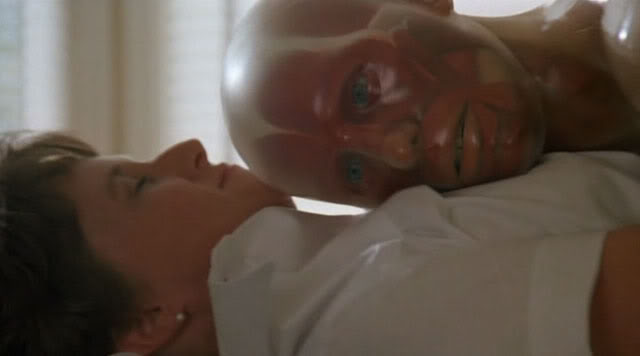
Leon and Ursula are the children of Dr. Linden (Terry O'Quinn), a small-town physician who keeps a skinless plastic dummy named Pin in his office as a teaching aid. To put his younger patients at ease with the unnerving dummy, the doctor throws his voice to make Pin speak, and the two exchange musings over the prognosis like colleagues. The doctor's children often sit in on his examinations, and have a timid friendship with Pin under their father's supervision (after all, he can't speak if Dr. Dad's not in the room).
Leon is especially fascinated by Pin, sneaking into the doctor's office after hours to speak to him alone--only to one day stumble upon a nurse taking advantage of Pin's anatomically correct features. Traumatized, seemingly more for Pin than himself, Leon makes it his mission to take Pin home to live with them, an obsession that carries on for years.
Who could resist those puppy dog eyes?
As they grow up, the children live fairly sheltered lives--Leon takes comfort in it while Ursula fights every step--until, in their teen years, both parents die in a car accident. Leon's first thoughts are to rescue Pin from his father's office and finally bring him home. Ursula is naturally against this, but Leon insists that Pin is part of the family and that families stick together. It doesn't take long for Leon to reveal the lengths of his devotion to Pin: dressing him in his dead father's clothes, covering his face and hands in latex skin, and of course, adopting Pin's soft, even voice.
Yeah, this is better.
While Leon writes bad poetry and languishes on their inheritance, Ursula wisely takes up a job at the library to get out of the house. There she meets Stan, a local student (in the book, a Vietnam vet) and a genuinely nice guy, and the two begin seeing each other. Leon feels that his sister is moving away from him and Pin, and he takes escalating measures to stop it, which--ahem--vary between the book and the movie. (More on that later.)
Things come to a head when Leon lures Stan to the house and attacks him, blaming his outburst on Pin's influence. Of course, because she's seen it coming from the beginning, Ursula is instantly suspicious and it doesn't take long for her to find evidence of Leon's sins. (In the movie, she finds Stan's watch under the couch and a wet spot on the carpet; in the book, she spots Stan's prosthetic leg in the fireplace.) In a whirl of emotion, Ursula runs out of the room and comes back with an ax, hacking Pin to pieces as Leon watches in horror. Leon is traumatized once again and regresses to a catatonic state--while book hints at his lingering nerve damage early on, the film portrays his paralysis as a direct result of the psychotic break. The book and the film end with Leon sitting in his wheelchair by the window, unmoving, the identity of Pin now having completely consumed him.
Whereas the novel is unmistakably psychological, the movie takes a cheekier approach, playing with the possibility that this family drama could turn into a living doll creepshow at any moment. When Pin speaks for the first time, the audience has a few moments of discomfort before its revealed that Dr. Distant Dad is a secret ventriloquist. When Pin sits up in the backseat, it's only briefly terrifying before being explained away as the results of plain old physics--hollow things move around in a moving car. It's a nice touch, and it works. Pin is in the eye of the beholder, and if you believe he is alive, then he is.
Alive enough.
One of the novel's more fascinating aspects is its sexuality, and all the messy, humiliating, inexplicable moments puberty brings. There's this notion, especially in film, that children are so delicate, so pure and innocent that the slightest depravity can warp them for life. It's not as if that isn't true--the world we live in is full of awful things that exist to corrupt our precious babies, so what is a terrified parent to do? Bubble them inside safe spaces lined with fear and ignorance and hope they never ever get out. In this sense, Leon and Ursula represent both the strengths and pitfalls of that parenting tactic.
Ursula is portrayed with a healthy sexual curiosity from the start. An early scene shows her, no more than eight, flipping through a dirty magazine and admiring a model's breasts, wondering aloud to her brother if hers will ever get that big. It's strangely touching by its very innocence, and all the more shattering when their mother walks in and rips the magazine away in disgust. Despite her sheltering, Ursula enjoys her sexuality as she gets older, until the inevitable happens: she gets pregnant. Dr. Dad performs her abortion, which pretty much destroys any notion of being with a man again...for a while, anyway.
Meanwhile, Leon is the polar opposite of a sexual awakening. Where his sister blossoms, he shrivels to almost manic asexuality, due in no small part to his own traumatizing first encounter with sex and his parents' stifling discipline. When his neat-freak mother finds muddy prints on her rug, she forbids him to invite friends to the house ever again. His stoic father is cold and unknowable--his soft side only comes out when he lends a papery voice to a horrifying doll. Leon's only confidants are the wise and gentle Pin, the only father figure he's ever known and Ursula, the beautiful little sister he adores and resents in equal measure. Leon denies he even has a sexuality and violently chastises Ursula for acknowledging her own. The film never directly addresses if Leon is overly protective or jealous of his sister, but the book makes it clear that he is very much in love with her, teetering on obsession.
"Pin, would you say grace?"
Their warped relationship is solidified by a couple of steamy scenes in the pages of the novel that were never going to make the movie. As curious preteens, they experiment with Pin under Leon's instruction based on his encounter with the nurse. As they grow older, Leon almost insists that Ursula use Pin exclusively to satisfy what their father called The Need, in an effort to keep her away from boys at school. When Stan enters the picture, Leon resorts to forcing Pin (and by extension, himself) upon Ursula, convinced that if she only remembers how good it used to be, she won't want to leave them. It's perhaps the most twisted scene in a very bizarre book, and it's definitely the moment that caught the attention of V.C. Andrews' estate.
The one thing that doesn't sit quite right with me is the film's focus on Leon's mental illness, and I do mean those italics. They go so far as to have Ursula tearfully diagnose him as a paranoid schizophrenic based on freehand library research. Portrayals of mental illness in movies rarely age well, but they are more tolerable if the film avoids giving the condition a name. Some may take issue with the "just plain crazy" explanation for various reasons, but to them I say this: Psycho is a masterpiece with the exception of that parlor scene at the end, where a smooth professional comes in to explain precisely what happened and why. For the sake of the story, it's better for the audience to draw their own conclusions from what the film presents rather than have a specific diagnosis.
He taught me how to please a woman and helps with my homework!
I have seen and read some wild stuff in my day, but few things have stuck with me like PIN. I have a soft spot for stories that take a concept and push it to the brink, unafraid to venture into the bizarre depths of human darkness. Both the book and the film are great campy fun with a streak of unnerving weirdness throughout, and they show just enough for the mind to chew on long after the credits roll. So if you have a rainy afternoon to yourself and wish to step into the world of the miserable incestuous upper class, then follow me into the doctor's office, and let Pin examine you.